
Rapamycin Heart Health Breakthrough: New Study in Older Adults Shows Promise
By Nicolas Musi, MD — Barshop Institute for Longevity and Aging Studies, University of Texas Health Science Center at San Antonio
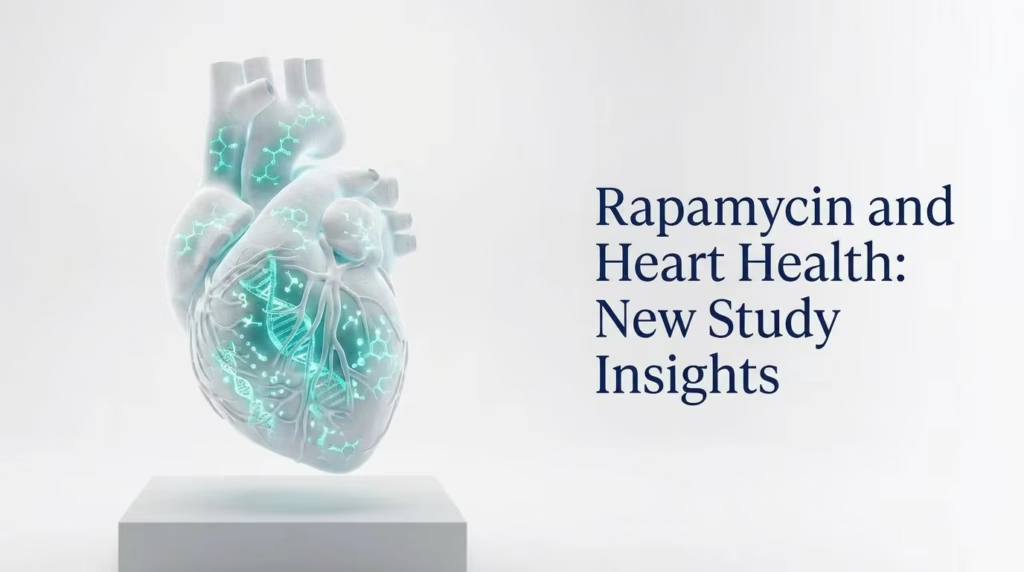
New study by Dr. Nicolas Musi shows rapamycin heart health improvements and enhanced vascular function in rapamycin in older adults, revealing its potential as a cardioprotective longevity therapy.
For more background on the science behind these benefits, see Rapamycin Heart Health Study.
A New Chapter in Rapamycin Research
Aging brings its share of challenges, especially for heart health. As we get older, our hearts can stiffen, and blood vessels may not function as smoothly, increasing risks for conditions like heart failure.
Readers exploring how rapamycin impacts aging overall may also like Rapamycin and the Future of Healthy Aging.
But what if a drug commonly used in transplant patients could help reverse some of these age-related declines? A recent pilot clinical trial explores just that, testing low-dose rapamycin—a compound known for inhibiting the mTOR pathway, which plays a role in aging processes—on healthy older men.
To understand mTOR better, see Rapamycin and mTOR: The Hidden Switch Controlling Aging.
The results? Promising improvements in heart and vascular function, with no major side effects. These findings add to growing rapamycin research for cardiovascular aging, especially in the context of rapamycin research with elderly participants.
You can explore related longevity science here: Rapamycin and Longevity Science.
The Study Setup: Small but Focused
Researchers conducted an open-label pilot trial (no placebo group) on six healthy men aged 70 to 76. These participants were in good overall health, with no active heart disease or diabetes, though some had controlled conditions like high blood pressure.
They took 1 mg of oral rapamycin daily for eight weeks, a dose chosen for its safety profile based on prior studies.
Those interested in dosing effects can read Off-Label Use of Rapamycin: From Longevity to Weight Loss.
The team monitored them at baseline, four weeks, and eight weeks using advanced tools like cardiac MRI for heart function and laser-Doppler flowmetry for blood vessel health.
Blood tests tracked safety, inflammation, and drug levels, while simple physical tests assessed strength and mobility.
Similar clinical findings have been explored in Muscle Strength and Endurance in Older Adults With Rapamycin.
This structure helps expand clinical data on rapamycin in older adults and its potential role in healthy aging.
Key Findings: Boosts for the Heart and Vessels
The big wins were in diastolic function—the heart’s ability to relax and fill with blood between beats—which is crucial for preventing issues like heart failure with preserved ejection fraction (HFpEF), a common problem in older adults.
Specific improvements included:
• Increased peak left ventricular filling rate
• Better blood acceleration through the mitral valve
• Higher total blood volume entering the heart during relaxation
Endothelial function, which involves the inner lining of blood vessels and their ability to dilate for better blood flow, also got a boost. After eight weeks, participants showed significantly improved vasodilation in response to heat — a test of nitric oxide-mediated vessel health.
To explore similar vascular effects, see Rapamycin Vascular Health Effects.
These findings highlight meaningful rapamycin vascular health effects, reinforcing its potential in cardiovascular longevity.
On the physical side, right-hand grip strength increased noticeably, hinting at broader anti-aging effects.
For whole-body aging effects, see The Youth Pill: Shocking Scientific Discoveries About Rapamycin.
Systolic function (the heart’s pumping strength) saw minor changes, like a slight increase in end-systolic volume, but nothing dramatic.
Importantly, there were no adverse events; the drug was well-tolerated, with stable vital signs and only minor, non-clinically significant lab shifts (like a small rise in HbA1c or LDL cholesterol).
Inflammation markers, such as IL-6 and sICAM-1, didn’t change significantly overall, though individual trends suggested potential anti-inflammatory benefits that a larger study might confirm.
For related early clinical evidence, see Weekly Rapamycin for ME/CFS Trial Results.
This further supports ongoing rapamycin research for cardiovascular aging in the elderly population.
What Does This Mean? A Step Toward Anti-Aging Medicine
This study builds on animal research where rapamycin extended lifespan and improved heart function in mice and dogs by reducing inflammation, oxidative stress, and cellular damage.
Related pet findings:
• Rapamycin for Pets Longevity
• Rapamycin Slows Aging in Dogs
In humans, it’s already used in higher doses for organ transplants and cancer, but this low-dose approach targets aging itself—a concept from geroscience, which aims to treat age as a modifiable risk factor.
The improvements in diastolic and endothelial function are exciting because these decline with age and contribute to cardiovascular diseases. If replicated, rapamycin could offer a new tool for preventing heart issues in healthy older adults or even treating early HFpEF.
Those curious about systemic aging pathways can explore mTOR’s Role in Aging.
However, the researchers emphasize caution: This was a tiny, male-only group without controls, so it’s proof-of-concept at best. Future trials need to include women (as sex differences in rapamycin effects have been noted in animals), larger samples, and longer durations to assess real-world benefits and risks.
If validated, this could mark one of the most important milestones in modern longevity research: a therapy that not only extends life but preserves cardiovascular vitality well into older age.
For breakthroughs shaping the field, see The Revolution That Extends Life.
Conclusion: A Promising Direction for Healthy Aging
The pilot trial confirms that daily 1 mg rapamycin (RAPA) is safe and tolerable for healthy older men, with the study design suitable for evaluating mTOR inhibition’s cardiovascular effects.
Aligning with the geroscience hypothesis, it shows promise for mTOR inhibitors in mitigating age-related cardiovascular decline — particularly improving diastolic and vascular/endothelial function in those without evident disease.
To explore additional healthy-aging findings, read Rapamycin in 2025: New Findings on Aging and Immunity.
These findings justify larger, longer trials in healthy older adults and support testing in patients with impaired function, such as heart failure with preserved ejection fraction (HFpEF), which lacks effective treatments.
Overall, this contributes meaningful clinical insight into rapamycin in older adults, supporting future work on rapamycin heart health, rapamycin vascular health effects, and broader rapamycin research for cardiovascular aging.