
Rapamycin & Dementia: The 2025 Update on APOE4, Blood-Brain Barrier, and the ‘Double-Edged Sword’ of Autophagy
Can a drug originally used in organ transplant medicine hold the key to preventing Alzheimer’s disease? As we move into 2025, Rapamycin has transitioned from a niche “longevity molecule” to a primary subject of intense clinical investigation for dementia. Rapamycin is an FDA-approved mTOR inhibitor that researchers believe may slow the biological processes of aging itself, particularly those involving inflammation and vascular decline. Recent breakthroughs suggest that for APOE4 carriers, who face the highest genetic risk for late-onset Alzheimer’s, this intervention may offer a unique way to restore brain health.
This post explores how Rapamycin targets the blood-brain barrier, interacts with the APOE4 gene, and navigates the complex “double-edged sword” of cellular cleanup known as autophagy.
Understanding the APOE4 Connection and Rapamycin’s Role
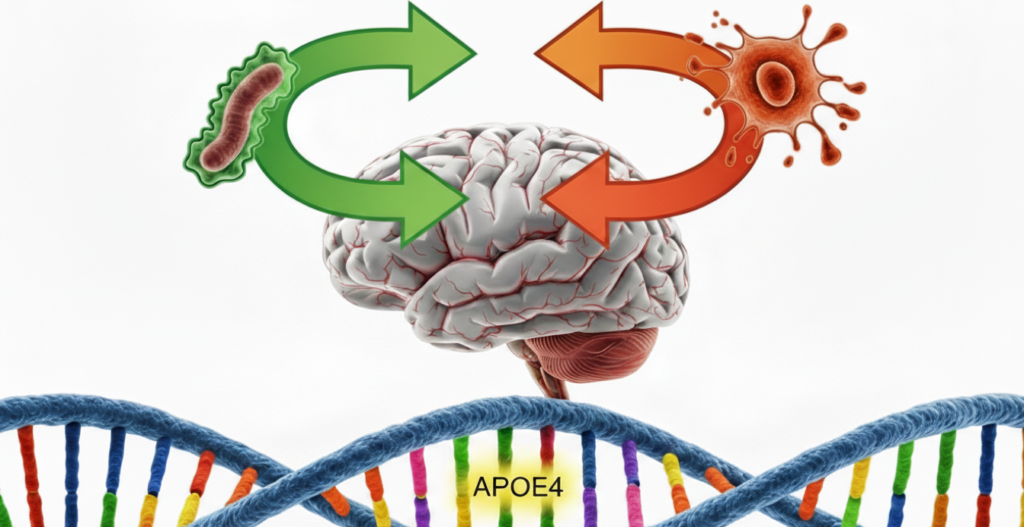
The APOE4 allele is the strongest genetic risk factor for late-onset Alzheimer’s disease. While the neutral APOE3 is more common, a single copy of APOE4 can increase risk by 3 to 7 times, and carrying two copies can boost risk by up to 12 or 15-fold. APOE4 carriers often exhibit brain metabolic and vascular deficits decades before hallmark symptoms like memory loss or amyloid plaques appear.
Recent 2025 updates from the Lin Brain Lab at the University of Missouri have provided some of the first human evidence that Rapamycin can address these early deficits. In a small pilot study, cognitively normal APOE4 carriers aged 45–65 were given a low dose of 1 mg/day for four weeks. The results were remarkable: participants showed significantly increased cerebral blood flow and restored volume in the hippocampus and caudate, two brain regions essential for memory and emotional regulation.
These findings suggest that Rapamycin studies are moving toward a “precision medicine” approach, focusing on individuals with the specific genetic risk that makes them most vulnerable to early brain aging.
The Blood-Brain Barrier: A Crucial Gateway for Alzheimer’s Prevention
One of the earliest “biological leaks” in the Alzheimer’s process is the breakdown of the blood-brain barrier (BBB). The BBB is a protective shield that prevents toxins from entering the brain while allowing nutrients in. In APOE4 carriers, this barrier is often more permeable, leading to neuroinflammation and reduced cerebral blood flow.
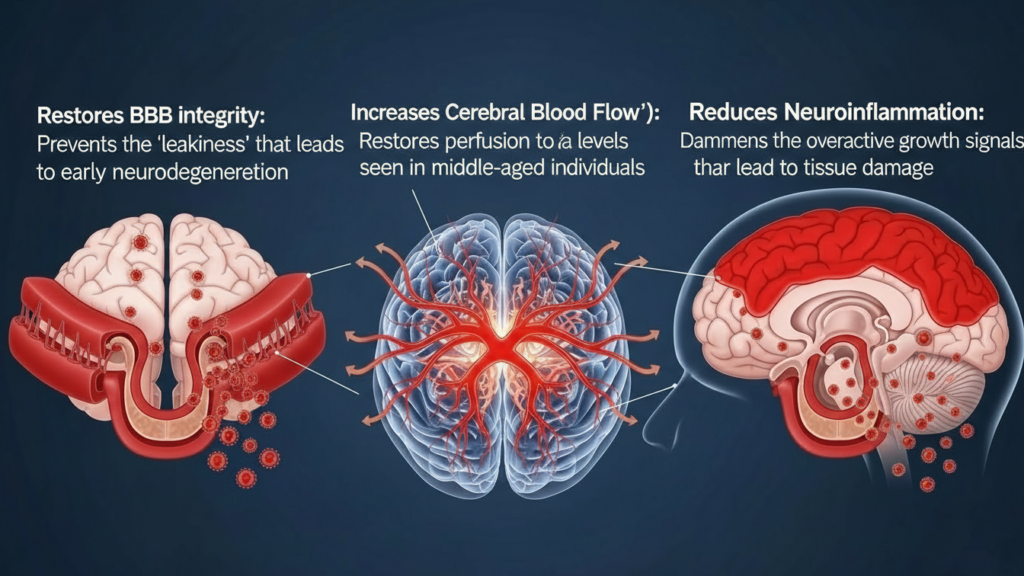
FIGURE: Key Benefits of Rapamycin for the Aging Brain
Researchers have identified that mTOR inhibition via Rapamycin can reduce proinflammatory pathways in the brain’s vasculature. By tightening the blood-brain barrier and improving blood circulation, Rapamycin may help the brain clear toxic proteins more effectively.
Autophagy: The ‘Double-Edged Sword’ of Brain Cleanup
At the heart of Rapamycin’s neuroprotective potential is its ability to induce autophagy. Derived from Greek for “self-eating,” autophagy is the body’s natural system for recycling damaged proteins and dysfunctional organelles. It acts like a cellular garbage disposal, which is vital because many dementias are caused by the clumping of toxic proteins like amyloid-beta and tau.
However, scientists refer to autophagy as a “double-edged sword”.
The Balance of Autophagy:
• The Good: When functioning correctly, it clears the “trash” that would otherwise cause neurons to die.
• The Bad: Excessive autophagy can theoretically lead to a type of programmed cell death (Type II autophagic cell death), where the cell devours too much of itself to survive.
• The Nuance: While low-dose Rapamycin appears to promote the “good” cleanup, the timing and dosage are critical3738. Some researchers argue that very early intervention is best, as the benefits may diminish once significant plaque burden is already present.
Rapamycin Studies: 2025 Human Data vs. Preclinical Findings
The transition from animal models to human trials has been the biggest theme of 2025. While Rapamycin consistently extends the lifespan of mice by up to 26%, human data are still emerging.
1. The PEARL Trial: This was one of the longest studies to date, following 114 healthy older adults for 48 weeks. It found that low-dose, intermittent Rapamycin (5–10 mg weekly) was safe and well-tolerated, with some women showing significant gains in lean muscle and reduced pain.
2. The CARPE_DIEM Trial: This study focused on individuals already diagnosed with mild cognitive impairment or Alzheimer’s. Interestingly, it found that a 1 mg/day dose did not reach detectable levels in the cerebrospinal fluid, suggesting that Rapamycin’s ability to cross the blood-brain barrier in humans may depend on higher doses or the presence of a “leaky” barrier.
3. Ongoing Trials: New studies like ERAP and REACH are currently investigating 7 mg/week and 1 mg/day doses, respectively, over longer periods to see if they can effectively slow cognitive decline.
Practical Considerations: Rapamycin Formulations and Usage
As interest in Rapamycin grows, many are asking about its availability as a supplement. It is important to clarify that Rapamycin is a prescription medication, not an over-the-counter pure rapamycin supplement.
Common Search Terms and Realities:
• Rapamycin supplement availability: It is currently only available via prescription from a physician, often for off-label use in longevity clinics.
• Rapamycin structure and formulations: Most clinical trials use oral tablets. Some specialized pharmacies offer compounded versions, though researchers note these may have lower absorption than commercial brands.
• Rapamycin skin cream: Topical formulations are FDA-approved for specific conditions like facial angiofibromas, and some “biohackers” use them off-label for anti-aging.
• Rapamycin side effects: At the low doses used for longevity, the most common issues are mild gastrointestinal discomfort and transient mouth ulcers.
FAQ: Rapamycin and Dementia
Can Rapamycin prevent Alzheimer’s in everyone? Based on current Rapamycin studies, it is too early to say it works for everyone. The most positive human results have been seen specifically in APOE4 carriers.
How does Rapamycin cross the blood-brain barrier? Rapamycin is highly lipophilic (fat-soluble), which generally supports its passage across the blood-brain barrier. However, human trials show mixed results on how much actually reaches the brain at low doses.
What is the best Rapamycin dosage for brain health? There is no “gold standard” yet. Trials have tested everything from 1 mg daily to 10 mg once per week. Most longevity experts favor low-dose intermittent protocols to avoid long-term immune suppression.
Conclusion
The 2025 landscape for Rapamycin and dementia is one of “cautious optimism.” While we do not yet have a definitive trial proving it prevents Alzheimer’s, the biological plausibility is stronger than ever. For APOE4 carriers, the ability of this drug to restore cerebral blood flow and support the blood-brain barrier represents a significant breakthrough.
However, because of the “double-edged sword” of autophagy and the risk of side effects, any use of Rapamycin must be done under strict medical supervision. If you are an APOE4 carrier or concerned about brain aging, the current recommendation is to focus on foundations like exercise and sleep while keeping a close eye on the results of the ERAP and REACH trials expected later this year.
Resource links
Insights in aging, metabolism and redox biology: 2024
Neurodegeneration Reversed with mTOR Inhibitor Drug in New Alzheimer’s Study
mTOR: Alzheimer’s disease prevention for APOE4 carriers
APOE4 Gene: What You Need to Know About This Alzheimer's Risk Factor
Rapamycin as a preventive intervention for Alzheimer’s disease in APOE4 carriers
Autophagy: Your Cell's Natural Cleaning Cycle
How Long Do You Need to Fast for Autophagy?
A mathematical model of p62-ubiquitin aggregates in autophagy
The Beneficial and Adverse Effects of Autophagic Response to Caloric Restriction and Fasting
Rapamycin treatment for Alzheimer’s disease and related dementias: a pilot phase 1 clinical trial
Low-dose rapamycin shows promise for enhancing healthspan in older adults
Influence of rapamycin on safety and healthspan metrics after one year
Rapamycin's Horizon: What Upcoming Clinical Trials Reveal About the Future of Rapamycin
Evaluating Rapamycin Treatment in Alzheimer's Disease Using Positron Emission Tomography (ERAP)